Custom Finnish Sauna Builders for Chicago’s North Shore & Lake Geneva
Luxury sauna design and construction — engineered for longevity, crafted
for wellness.
Our saunas are built on the promise that you will always get a personalized and thoughtful approach with attention to detail and high-quality service.
Contact us today to make your dream sauna a reality.
OUTDOOR ● INDOOR ● ELECTRIC ● WOOD BURNING
Not all Saunas are Built the Same
Many sauna companies install prefabricated kits.
Thin insulation. Poor ventilation. Improper heater sizing. Non-Architectural integration. A heat box placed inside a room.
A true Finnish sauna is different.
It is a permanent, properly engineered structure – designed for proper airflow, balanced heat, safe electrical systems, and long-term durability.
At Ciancio Engineering, we do not install kits.
We engineer, design and build custom indoor & outdoor saunas that become part of your home – structurally sound, code-compliant, and built to last decades.
Contact Us Today
"We hired Ciancio Engineering to build a custom sauna in our basement. They did a great job and incorporated some unique historical elements of our house. We appreciated their attention to detail and highly recommend them."
– C. Brown, Wilmette Homeowner
The Ciancio Engineering Difference
A Truly Custom Sauna: Designed. Engineered. Built.
Traditional Finnish Philosophy
- Wood-burning or electric heat options
- Proper bench heights and layout
- Balanced air circulation
- Authentic materials and construction
Structural & Mechanical Precision
- Insulation designed for harsh Illinois/Wisconsin winters
- Proper vapor barriers
- Electrical sizing and load calculations
- Ventilation engineered for comfort and longevity
Seamless Architectural Integration
- Indoor spa-style saunas
- Basement wellness suites
- Outdoor cedar-clad structures
- Lakefront retreat installations
- Modern, traditional, or Scandinavian-inspired designs
More Than a Statement Piece – A Long-Term Investment in Health.
Research shows daily sauna use has been associated with:
- Improved cardiovascular health
- Reduced stress
- Enhanced recovery
- Improved sleep
- Long-term wellness benefits
But beyond the research, a sauna becomes something more… It’s a place to disconnect. A ritual. A retreat within your own home.
For many of our North Shore and Lake Geneva clients, a custom sauna is not a luxury – it’s part of a long-term commitment to health.
Visit Blog for More on Sauna BenefitsServing Chicago’s North Shore & Southern Wisconsin
Licensed and insured in Illinois and Wisconsin, Ciancio Engineering builds custom saunas throughout the Northern suburbs including:
- Highland Park
- Highwood
- Lake Forest
- Lake Bluff
- Glencoe
- Wilmette
- Winnetka
- Kenilworth
- Evanston
- Glenview
- Northbrook
- Lake Geneva
- Fontana
- Williams Bay
- Delavan
- Lake Como
- Lyons
- Linn

A few examples of our Sauna Work
Sauna Resources & FAQs
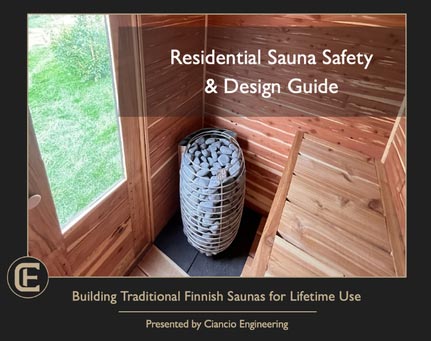
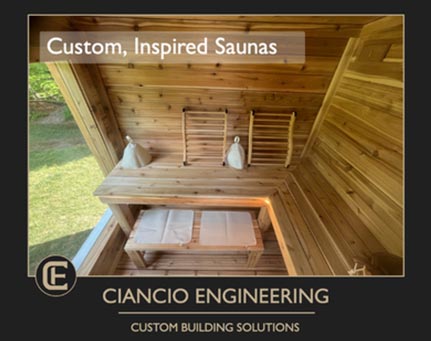
Research on long-term health outcomes has primarily focused on traditional electric or wood-stove Finnish-style saunas, which use high air temperature and heated stone mass to evenly distribute heat. While infrared saunas are also popular, most of the available research is centered around Finnish-style saunas.
Traditional Finnish saunas can generate heat ranging from 160 to 200°F. These environments use dry heat with optional steam from water poured on hot stones.
Research studies show that 10- to 20-minute sessions followed by a period of cooling down is optimal.
Research recommends frequent sauna usage 4 to 7, 20-minute sessions per week. This emphasizes regularity while avoiding excessive durations or intensities.
Yes. sauna use is well tolerated daily by healthy individuals who limit session duration to around 20-minutes, hydrate before and after usage, and avoid alcohol consumption in proximity to when you use the sauna. If you have cardiovascular disease, high blood pressure concerns, are pregnant, or sensitive to heat you should speak with a physician before starting a sauna regimen.
Yes. observational studies show that regular sauna use has been associated with lower rates of fatal cardiovascular outcomes. The research also shows improvements in vascular function and blood pressure.
According to long-term follow-up from the Kuopio Ischaemic Heart Disease (KIHD) study of 2,315 middle-aged men.1 After adjustment for standard cardiovascular risk factors:
- Men who used a traditional Finnish sauna 4 to 7 times per week had substantially lower rates of fatal cardiovascular disease than those who only used the sauna once per week.
- Men who took 4 to 7 saunas weekly had about a 63% lower risk of sudden cardiac death.
- Men who took 4 to 7 saunas weekly had roughly a 50% lower risk of fatal coronary heart disease.
- Men who took 4 to 7 saunas weekly had roughly a 48% lower risk of fatal cardiovascular disease.
Yes. Observational studies suggest regular sauna use has been associated with lower rates of dementia and Alzheimer’s disease.
While these studies cannot prove that sauna use reduces dementia risk. The KIHD cohort – studied over 20 years – does show very strong associations between frequent sauna and reduced dementia and Alzheimer’s. 2
- Men taking 4 to 7 sauna sessions weekly had about a 66% lower risk of developing any dementia.
- Men taking 4 to 7 saunas sessions weekly had about a 65% lower risk of Alzheimer’s disease
- While the working mechanisms are not yet fully understood, researchers believe improved vascular health, lower blood pressure, decreased inflammation, and autonomic balance may be partly responsible for sauna’s association with reduced dementia and Alzheimer’s risk. 3
Yes. Observational studies following individuals for many years show that frequent sauna use may lower risk of certain respiratory illnesses, such as pneumonia.
Yes. Your liver and kidneys are your body’s natural detoxification system. Sweating can assist with elimination of certain compounds but should not be thought of as a detox activity on its own.
Yes. We believe a sauna – especially a Finnish-style sauna – should be installed as a permanent building system like many other long-term components of your home, like an HVAC system. Unlike kit saunas and portable pop-up tent-like saunas, a true Finnish sauna is a complex structure requiring special attention to thermal, moisture, electrical, and structural factors
Yes. Indoor saunas can be installed in cold climates but there are important details related to heat type, vapor control, insulation, ventilation, and managing moisture to prevent condensation. You should consult experts like Ciancio Engineering who specialize in high-performance custom saunas.
Electric-heated saunas allow for tighter temperature control and easier integration with modern houses. Wood-fired saunas require additional considerations for chimney, combustion air, fire safety, and code compliance. There is also the convenience factor associated with an electric heater, and many can be controlled remotely via an app on your phone.
Ventilation provides fresh oxygen, increases comfort, evenly distributes heat, and reduces stale air buildup. Proper ventilation also manages moisture during and after sauna sessions.
Inadequate ventilation can create uneven heating, stuffy air, high humidity, and excess moisture that can condense on surfaces and potentially damage materials over time.
Cold outdoor temperatures create higher temperature differentials with sauna heat. This can lead to more condensation when the sauna cools down. Proper design and installation from experts will limit condensation trapped in wall assemblies.
Materials should be chosen that can perform reliably under high heat and moisture cycles. This includes thermal stability at higher temperatures and being compatible with your vapor control strategy. Traditionally, cedar performs well in these environments. Consult an expert design/installer to help with material selection.
A sauna can and should last for decades if the enclosure, ventilation, and moisture control systems designed and managed correctly during installation. An annual inspection and routine maintenance will ensure the sauna’s components are functioning properly and safely.
Preheat the sauna to your ideal temperature (160 to 200°F). Hydrate before your session and avoid drinking alcohol. Start with a moderate temperature if you’re new to sauna use and work your way up to longer sessions and higher temperatures.
Cooldown, hydrate, replenish electrolytes, and allow for rest/recovery between sauna sessions if you’re using them frequently.
Allow the sauna to dry between uses, keep surfaces clean with mild cleaners, avoid harsh chemicals, and inspect the sauna heater and controls periodically for buildup.
Yes. Traditional Finnish sauna users often pour water on hot stones to increase humidity and create steam as desired. Your sauna should be designed to accommodate steam if you plan to utilize this practice.
Yes. Saunas can and should be designed with long-term comfort and accessibility in mind. Stable flooring, appropriate bench height, lighting, and spacious movement paths should be carefully considered during the design phase